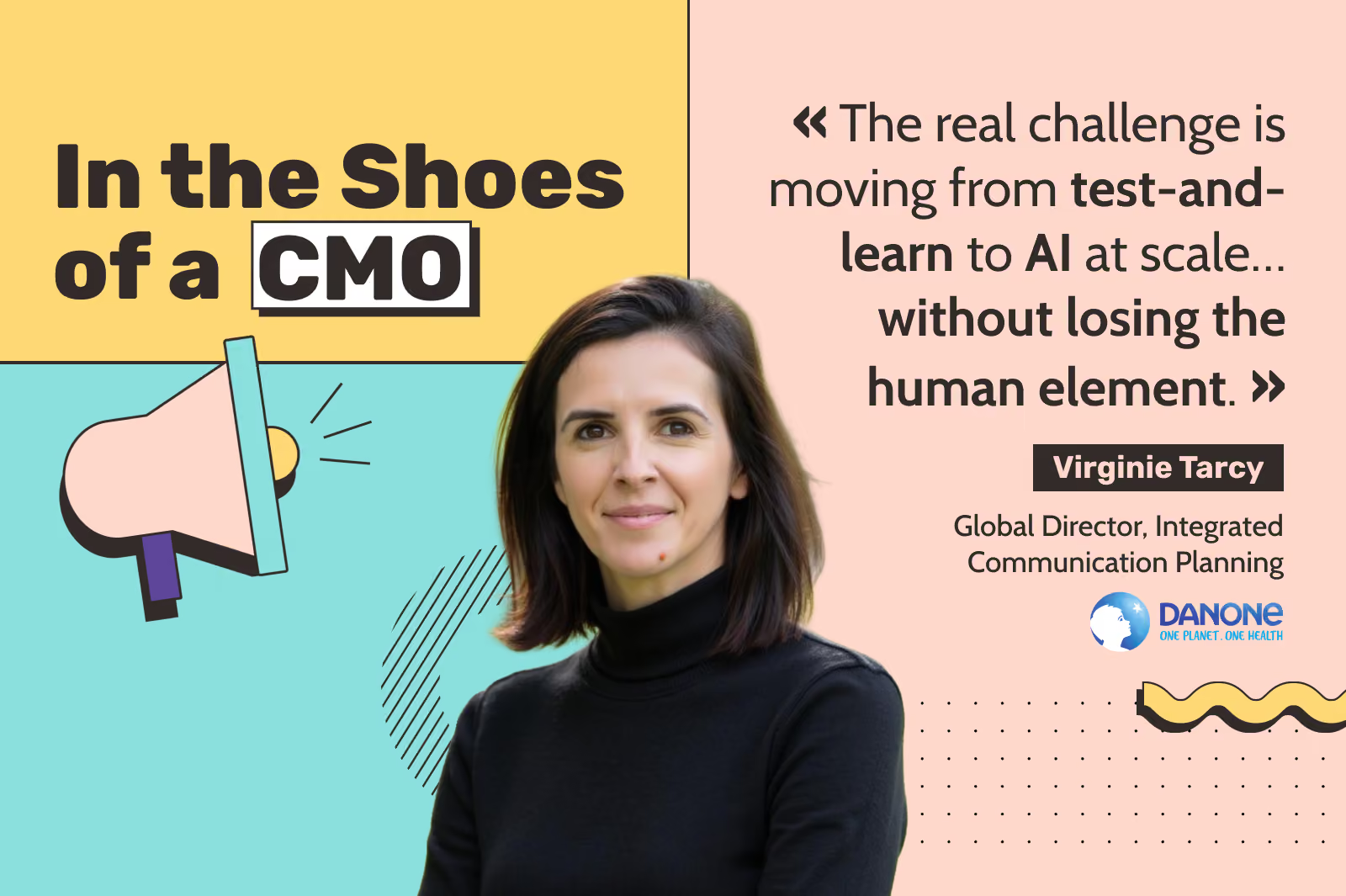
In the Shoes of a CMO: Virginie Tarcy (Danone) on AI, Global Marketing & Integrated Communication Strategy
BtoC
Growth Marketing
Marketing
hypergrowth
With around fifteen years’ experience in digital marketing, Virginie Tarcy has navigated between FMCG, healthcare and sport. After Bel, a role in pharma and a deep dive into the hospitality programme for the Olympic Games, she has just joined Danone as Global Director, Integrated Communication Planning.
Her role: orchestrate integrated campaigns for the group’s major global brands (Danone, Aptamil, Alpro, Actimel…), aligning strategic vision, local execution, data, creative and media. With a strong conviction: AI only has value if it serves business performance, fits within solid governance… and never makes us forget the human.
Virginie Tarcy: I break them down into three blocks: performance, orchestration and transformation.
On performance, the goal is to ensure every brick (data, content, experience, media) genuinely contributes to growth. In an environment where technologies are multiplying, you have to optimise, prioritise and sometimes stop certain initiatives rather than layering them on.
Orchestration is just as key: aligning a global vision with very different local markets, getting creative, media and data to work together, and installing a shared framework. Without that framework, everyone moves according to their own logic and collective effectiveness erodes.
Finally, transformation, driven by AI and automation. We’re moving out of pure “test and learn” everywhere: now we need to install models that can scale, with real governance and clear rules of the game.
V.T.: For the Olympics, we had to sell an experience, because we didn’t yet have a finished product. AI was useful for creating visuals and 3D immersions, but the exercise was constrained: the Olympic brand is heavily protected, guidelines are strict, and assets are hard to generate automatically. In some cases, AI actually made us lose time.
Another limitation: local culture. Some markets, like China, required codes and usages that were very far from those in Europe or the US. We had to recreate specific assets, which heavily reduced automatic personalisation.
Conversely, in the United States, AI tools for media personalisation were already available and effective, unlike in Europe. The impact of AI therefore varies a lot from one market to another: its effectiveness is highly dependent on market maturity and local constraints.
V.T.: We’re clearly in the scaling phase. Dedicated teams identify the right use cases (content, media, personalisation) and organise global rollout: choice of tools, training, security.
AI forces you to structure governance: which uses are authorised, what limits to set, who is responsible for what. It’s no longer a standalone topic, but a transversal issue that affects creatives, legal, media and beyond.
V.T.: There’s a simple truth: the consumer remains local. Cultural, economic and political contexts all change from one country to another. At a global level, the priority is staying connected to realities on the ground.
Practically, that means local teams, partners (Kantar, Nielsen, media agencies) and internal insight units capable of producing fine-grained data, both qualitative and quantitative. For the Olympics, sport and emotion were our anchor points. At Danone, the signals are more diffuse (nutrition, health, purchasing power), which makes it even more important to maintain a constant link with markets.
V.T.: At Danone, agencies and consultancies are not just suppliers, they’re integrated partners. They’re involved from the exploratory phase, contribute to insights, challenge brand objectives and co-build creative platforms.
It’s a deliberate choice: business transparency is essential to ensure coherent creative and media orchestration.
V.T.: When you work with data experts, creatives, marketers, local teams and external partners, clarity becomes essential: why we do things, which business objective it serves, what role each person plays.
Then you have to create regular moments of collaboration to avoid silos. In the current environment, the attention you pay to teams is just as important as the target you’re aiming for.
V.T.: There are no “miracle new profiles”. Jobs evolve, titles change, but what really sets a talent apart are core skills: tech orientation, creative sensibility, ease with storytelling and copy, product instinct, organisational rigour…
Younger generations are digital natives – that’s no longer a differentiator. On AI, it’s up to the company to train and support: no one arrives as an expert in generative AI or Copilot. What I’m looking for above all is curiosity. Where it lives, on which topics it shows up. That’s what shapes future trajectories.
Internal training programmes then allow people to test, grow and move across different areas within marketing.
V.T.: I’d start from the mantra that made me want to join Danone: bringing health through food to as many people as possible. That implies two things: staying obsessed with the needs of the consumer or patient, and ensuring product innovation truly answers those needs.
When the product is good, everything becomes simpler: communication gains in fluidity, credibility and effectiveness. The CMO’s role then becomes that of an architect: connecting insight, product, creative, media, AI and people to maintain a single, coherent direction.
L’équipe Spaag.
Spaag is a consulting firm specialising in growth marketing, digital marketing, data, and AI. Our mission is to support our B2B and B2C clients in achieving their business objectives, both in France and internationally.




.png)