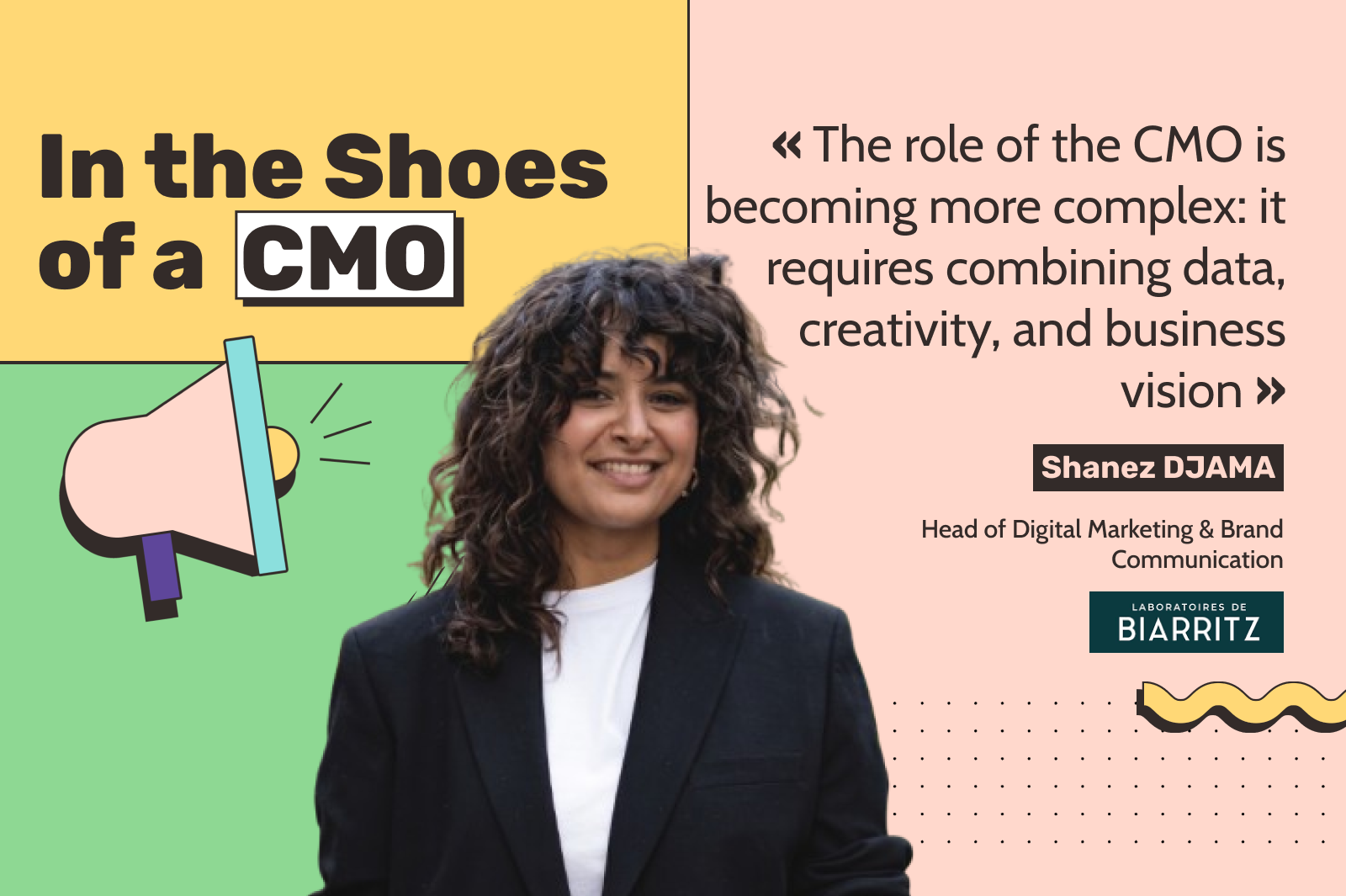
In the Shoes of a CMO: Shanez Djama on AI, Data & the Future of Marketing at Laboratoires de Biarritz
AI
GEO
Future of marketing
Growth Marketing
6/5/26
Founded in 2011 with the ambition to create sunscreen products that are both highly effective and respectful of skin and the ocean, Laboratoires de Biarritz has established itself as a distinctive brand in the dermo-cosmetics and skincare industry. Distributed through pharmacies, organic retail stores, e-commerce channels, and available in more than 25 countries, the company recently entered a new phase of growth following investment from La Phocéenne de Cosmétique, owner of brands such as Le Petit Olivier, Lovea, and Laboratoires Vendôme.
As Head of Digital Marketing and E-commerce, Shanez Djama leads a four-person team while coordinating with multiple external partners. From AI integration and customer data strategy to e-commerce platform migration and omnichannel marketing coordination, her role reflects the rapid transformation of the modern Chief Marketing Officer.
Shanez Djama:
Three major topics are currently driving our marketing strategy.
The first is artificial intelligence. We are exploring both how AI can be integrated into our internal organization and how it can improve the customer experience. We already use AI for selected creative assets, while maintaining clear limits to preserve brand authenticity. We also leverage AI to challenge and refine our creative strategy, influencer marketing, and campaign thinking.
At the same time, we are integrating an AI sales assistant, Qloa, into our e-commerce website. It will initially support pre-sales and customer service before progressively contributing to conversion optimization and customer journey management. More broadly, we are also starting to address new AI-powered search environments through GEO (Generative Engine Optimization), exploring how our content can remain visible within AI-driven search interfaces.
The second major topic is customer data and retail analytics. We are seeing major performance gaps between e-commerce and pharmacy sales channels. Some product ranges perform extremely well online but underperform in physical retail. The challenge is understanding these differences to improve our retail marketing strategy and channel-specific activation plans.
Finally, we are working on our e-commerce tech stack. We currently operate on PrestaShop, but we are reaching limitations regarding data accessibility and analytics. We are preparing a migration to Shopify, which would provide more actionable reporting, improved customer segmentation capabilities, and easier RFM analysis.
S.D.:
Internally, our marketing organization is split into two main areas: a content and acquisition team, and a commerce team handling the website and marketplaces. We also collaborate closely with an art director and graphic designer to maintain brand consistency across channels.
External partners are essential to our growth strategy. We cannot internalize every marketing expertise. Agencies help us upskill internally while also bringing strategic structure and flexibility. I personally prefer smaller, senior-led agencies that combine strategic thinking with operational agility. We have previously worked with larger agencies that were less adapted to our company size and sometimes relied too heavily on junior profiles.
Since joining a larger group, we have also started mutualizing certain agency partnerships across brands. This requires more coordination, but it can also create operational efficiency and stronger governance.
S.D.:
I value mindset and interpersonal skills just as much as technical expertise. I would rather work with someone adaptable, collaborative, and capable of evolving within cross-functional environments than with a highly specialized expert who works in isolation.
We have a team that is deeply committed to the brand, and that engagement is a real performance driver. The better people feel within the organization, the more effective they become. In a fast-changing marketing environment, team cohesion is critical.
S.D.:
These are fundamentally different business models.
Pharmacy distribution relies heavily on commercial relationships, field teams, negotiations with retail networks, and local proximity. E-commerce operates through digital acquisition, content marketing, CRM, and direct-to-consumer engagement strategies.
The key challenge is coordination. We align major campaigns, product priorities, and strategic messaging while still adapting to the realities of each channel. Internationally, we work with distributors who localize the strategy for their markets. However, we maintain full control over our own e-commerce website because it remains the brand’s primary digital storefront and directly reflects our image.
S.D.:
We worked with Spaag on an RFM analysis (Recency, Frequency, Monetary), which helped us better understand customer behavior and build more relevant audience segments.
At the time, email marketing was not a strategic priority and represented only around 10% of total revenue. By restructuring the CRM database and optimizing acquisition sources, we quickly improved performance through stronger external support and a more advanced A/B testing strategy.
We eventually reached a solid operational rhythm with two email campaigns per week sent to a database of around 100,000 contacts. Today, email marketing generates nearly 30% of our revenue.
We also integrated Klaviyo and use tools such as SAP and Microsoft Power BI to deepen our marketing analytics capabilities.
At the same time, we recognize that some of our current tools are overly complex or not fully adapted to our scale. The real challenge now is simplification: enabling teams to spend less time operating tools and more time analyzing data and making decisions.
S.D.:
I do not believe the CMO role will disappear, but it will clearly become more complex. Future marketing leaders will need to combine data expertise, creativity, leadership, and strong business understanding.
AI will transform marketing jobs, but I see it primarily as an opportunity. The real risk is not moving fast enough. Marketing is one of the functions most directly exposed to AI disruption, so marketers also have a responsibility to lead these conversations internally.
The CMO role will also become increasingly visible at board level, with greater pressure to defend strategic decisions — including investments whose impact may not always be measurable in the short term.
S.D.:
I would expect much deeper AI integration across all company processes, along with a stronger ability to leverage customer data and marketing analytics.
Today, we still lose too much time managing overly complex systems. There are technologies capable of simplifying operations, reducing executional workload, and allowing teams to focus more on strategic analysis and decision-making. That is where the biggest opportunity lies.
L’équipe Spaag.
Spaag is a consulting firm specialising in growth marketing, digital marketing, data, and AI. Our mission is to support our B2B and B2C clients in achieving their business objectives, both in France and internationally.