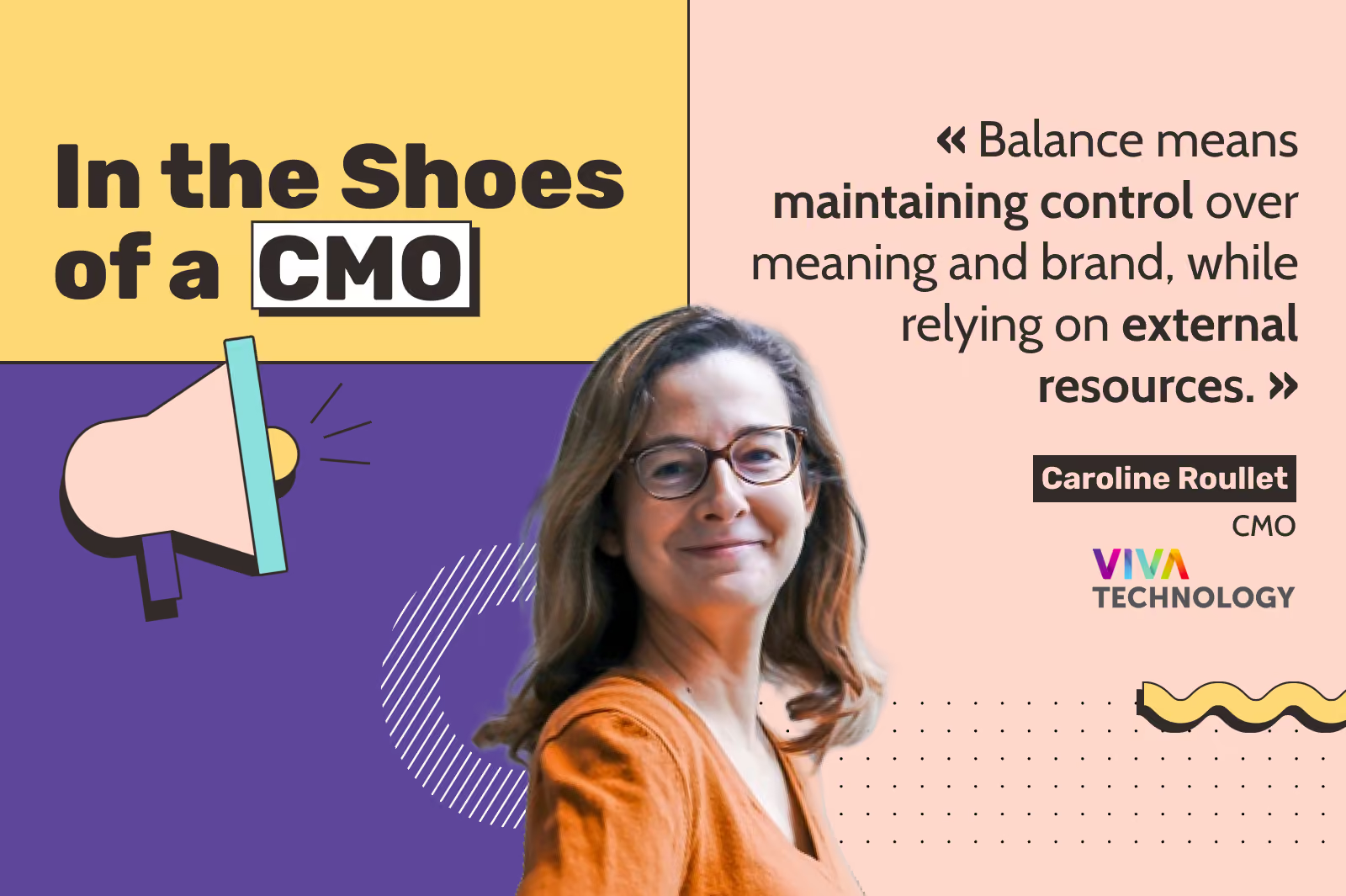
In the Shoes of a CMO: Caroline Roullet (VivaTech) on Brand Building, AI & Global Event Marketing
BtoC
AI
hypergrowth
Growth Marketing
Caroline Roullet (VivaTech): “The balance is about keeping control of meaning and brand, while leveraging external resources”
For the past ten years, Caroline Roullet has helped turn VivaTech into one of the world’s leading technology events. For its anniversary edition in 2026, the event welcomed 200,000 visitors from 165 countries, more than 15,000 startups and 4,500 partners, while generating significant international media coverage. Leading a marketing and communications team of around 25 people, structured across performance, media and brand, the CMO faces a dual challenge: strengthening a global brand in an increasingly competitive environment and turning that visibility into measurable impact.
Caroline Roullet: My challenges clearly sit at the intersection of brand and performance. In an ecosystem where tech events are multiplying, VivaTech has to stand out: strengthening brand personality, differentiating ourselves, and building international awareness among B2B audiences that can sometimes be hard to reach. At the same time, pressure on ROI has increased significantly. After a more flexible period, expectations have shifted back toward very ROI-driven demands, with a strong focus on short-term profitability. At VivaTech, we still have the ability to think more broadly and invest beyond the short term, but immediate performance has clearly moved back to the center of the conversation.
C.R.: In the early days, we relied heavily on improvisation and resourcefulness. Very quickly, we partnered with research institutes to ground our decisions in solid data, but the core of our insights still comes directly from our audiences. We combine quantitative and qualitative research, we continuously listen to the market, not just in the lead-up to the event. We also have an editorial team responsible for conferences, constantly monitoring what’s happening across the business and technology landscape. This helps us anticipate the topics that will matter most to our visitors and partners months or even years ahead. And with nearly ten years behind us, VivaTech benefits from strong audience loyalty. We’ve built communities that we engage with year-round, allowing us to adapt the event to their needs rather than speaking to them just once a year.
C.R.: Contrary to how it may look from the outside, nothing happened all at once or at massive scale. VivaTech’s brand awareness was built progressively. In the early days, we didn’t even know whether the next edition would take place. Sometimes we planned our marketing just a month before the event, simply because we had to be cautious with investments. Over time, we gained the ability to plan further ahead, working with three-year horizons and clearly defined milestones.
C.R.: We do a lot in-house, especially when it comes to the core of the brand. Art direction, for example, remains internal. It’s part of our DNA, our way of shaping VivaTech’s identity, and it’s not something we outsource. On the other hand, we rely on agencies for paid media, large-scale public relations (we manage nearly 2,700 journalists over four days), and part of the event production, with an agency that has supported us since the very beginning. The balance lies in maintaining control over meaning and brand, while tapping into external expertise when scale or technical complexity requires it.
C.R.: We were never formally “assigned” an AI roadmap just because we’re a tech event, but it would have been strange not to engage with the topic. We’ve defined a clear framework for AI usage. In marketing, AI primarily helps us simplify certain tasks: summarising conference sessions more quickly, analysing data faster to form initial hypotheses before diving deeper. It also allows us to deploy far more segmented campaigns. Micro-segmentation used to be difficult to justify from a human-effort perspective; with AI, it becomes both feasible and valuable. That said, it doesn’t replace teams. We do emotion-driven marketing. Our role is to convey what VivaTech stands for, to make people feel a brand that we’ve deliberately built to be vibrant and welcoming. AI is a powerful tool, but it’s neither a magic wand nor a substitute for the human dimension of marketing.
C.R.: I’ve built a highly international team, mostly composed of specialists. It forces us to move beyond purely French ways of thinking: an idea that feels obvious in Paris may not resonate elsewhere. This diversity helps us better address global audiences. We all work in English, and the nature of event marketing naturally fosters a strong team spirit. During peak periods, everyone supports each other, myself included. That collective energy more than compensates for the complexity that comes with diverse profiles.
C.R.: I look for people who are agile, open-minded and willing to take risks. Event marketing is a highly codified industry, with long-established ways of doing things. VivaTech’s DNA is precisely about breaking those codes and rethinking the experience. That requires people who don’t set limits too quickly, who bring ideas and don’t rely solely on past achievements. I also strongly believe that good marketers need to be aligned with the values of the brand they represent. You can technically “do marketing” for any product, but if you don’t genuinely believe in it, a disconnect inevitably appears in the way the story is told.
C.R.: In tech, if you don’t continuously train your teams, you quickly fall behind. We combine different formats: exchanges with other companies, individual coaching, tool-focused training, e-learning, and more. This helps develop both technical and managerial skills. The real challenge for a CMO is finding the time to learn personally, caught between operational demands and strategic responsibilities. But on topics like AI, it’s essential. You need to understand the use cases in order to make informed decisions and support teams with credibility.
L’équipe Spaag.
Spaag is a consulting firm specialising in growth marketing, digital marketing, data, and AI. Our mission is to support our B2B and B2C clients in achieving their business objectives, both in France and internationally.



.avif)