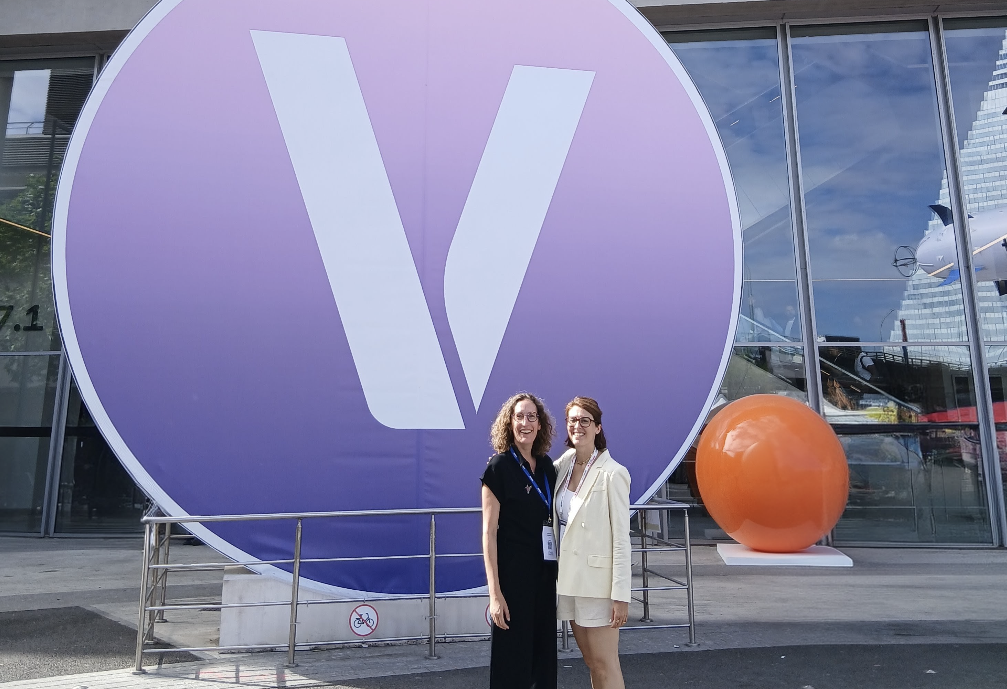
Conversation with Charlotte Colos-Gillardeau at VivaTech: AI Adoption, Marketing Transformation and Change Management
Marketing
19/6/26
Since 2022, Charlotte Gillardeau has led marketing at KPMG France. A strategic role she helped build from the ground up within a complex organization spanning multiple disciplines, business lines, and geographies.
Over the past three years, she has driven a broad transformation agenda: improving CRM adoption, strengthening data-driven decision-making, modernizing digital tools, and building AI capabilities across the marketing function. Her objective is clear: position marketing as a true business performance driver.
We sat down with a CMO whose role extends far beyond communications, acting as an orchestrator of transformation and a strong advocate for marketing accountability.
Charlotte Gillardeau: Artificial intelligence is a major priority for us. Marketing is one of the functions most impacted by AI, whether through content generation, translation, design, or automation.
We made the decision to bring our teams into this transformation early. That requires reassuring people, providing training, testing tools, and redesigning processes. In one year alone, we identified more than 70 use cases, launched a dozen automations, and, most importantly, equipped employees with practical AI skills.
AI is a powerful productivity lever, but it does not replace people. It augments us, provided we know how to use it correctly. We still need critical thinking, verification, and new ways of working. What I advocate for is a demanding approach where people remain at the center. As a leader, my role is to guide this transition and help teams develop new capabilities without losing ownership of their work.
Another major challenge is proving marketing's direct contribution to business performance. We spend a lot of time thinking about how to turn marketing into a true P&L-driven function: connecting campaigns to commercial opportunities, measuring impact through CRM systems, building the right dashboards, and strengthening alignment with business development teams.
The objective is to move beyond awareness alone and toward a broader performance mindset.
C.G.: The goal is to create a unified organization focused on customer experience.
We redesigned our website with a stronger business orientation, deployed a new LinkedIn strategy, cleaned and enriched our contact database, introduced a refreshed brand signature, refined our tone of voice, and strengthened employee advocacy initiatives.
This is not simply a transformation of tools. It is a transformation of mindset. Marketing is no longer an execution function; it is a business partner.
C.G.: We still recruit for technical expertise, but increasingly we hire for mindset.
Two qualities have become essential: curiosity and agility.
These are skills that need to be cultivated because they do not come naturally to everyone. Some people, including younger professionals, still struggle to challenge existing habits or step outside their area of expertise.
Marketing evolves constantly. Professionals must be able to navigate strategic and operational topics while collaborating across product, data, technology, and sales functions.
We live in a constant tension between short-term execution and long-term vision. Teams need to test quickly while maintaining strategic direction. That requires both intellectual and emotional agility.
C.G.: Our culture is primarily focused on building capabilities internally.
The objective is not to outsource execution but to accelerate learning and improvement. We occasionally work with external partners on specific topics to challenge our assumptions and help us progress.
Having an external perspective is critical. The project we conducted with Spaag is a good example. Together, we carried out a digital marketing audit. Their role was not to execute on our behalf but to challenge our practices, bring market benchmarks, and uncover blind spots.
I personally championed the initiative because I need people who are willing to tell me where things are not working. It is a demanding mindset, but an essential one if you want to improve.
C.G.: Strengthening the connection between marketing and Business Development is a key priority.
For the past year, both functions have been grouped within the same leadership structure, which has significantly improved alignment. We work closely together to connect marketing initiatives with commercial opportunities.
However, there is still work to do. Marketing is sometimes perceived as a lever that can deliver immediate results, without always accounting for the time required to create, adapt, and execute effectively.
Another challenge is prioritization. Organizations need clear rules, shared objectives, and coordinated execution.
Our multidisciplinary structure is a major advantage in this regard. We bring together sector expertise, regional teams, and functional specialists, allowing us to identify synergies and create more targeted approaches for our audiences.
Twice a week, our MarketCom teams meet across business units to share priorities, identify opportunities for collaboration, and better serve our key personas.
C.G.: I would ask them to run marketing like a true business unit.
Marketing should move beyond being viewed as a support function and demonstrate how every initiative contributes to company performance.
That requires a shift in mindset, but also stronger prioritization. Trying to do everything means prioritizing nothing.
Marketing leaders must be willing to make choices. That is how value is created.
C.G.: Our greatest strength is our multidisciplinary model.
We are able to support clients across the entire value chain through expertise in audit, consulting, legal services, technology, and more.
That diversity is also reflected in our marketing approach. Because our expertise is so broad, we need highly targeted personas and tailored communications.
It is not always easy, but it is what creates value and differentiation.
L’équipe Spaag.
Spaag is a consulting firm specialising in growth marketing, digital marketing, data, and AI. Our mission is to support our B2B and B2C clients in achieving their business objectives, both in France and internationally.