In the shoes of a CMO: Jean-Paul Bouteloup (PwC) on brand & sales alignment, AI and the transformation of B2B marketing
Marketing
Key Takeaways
In the shoes of a CMO
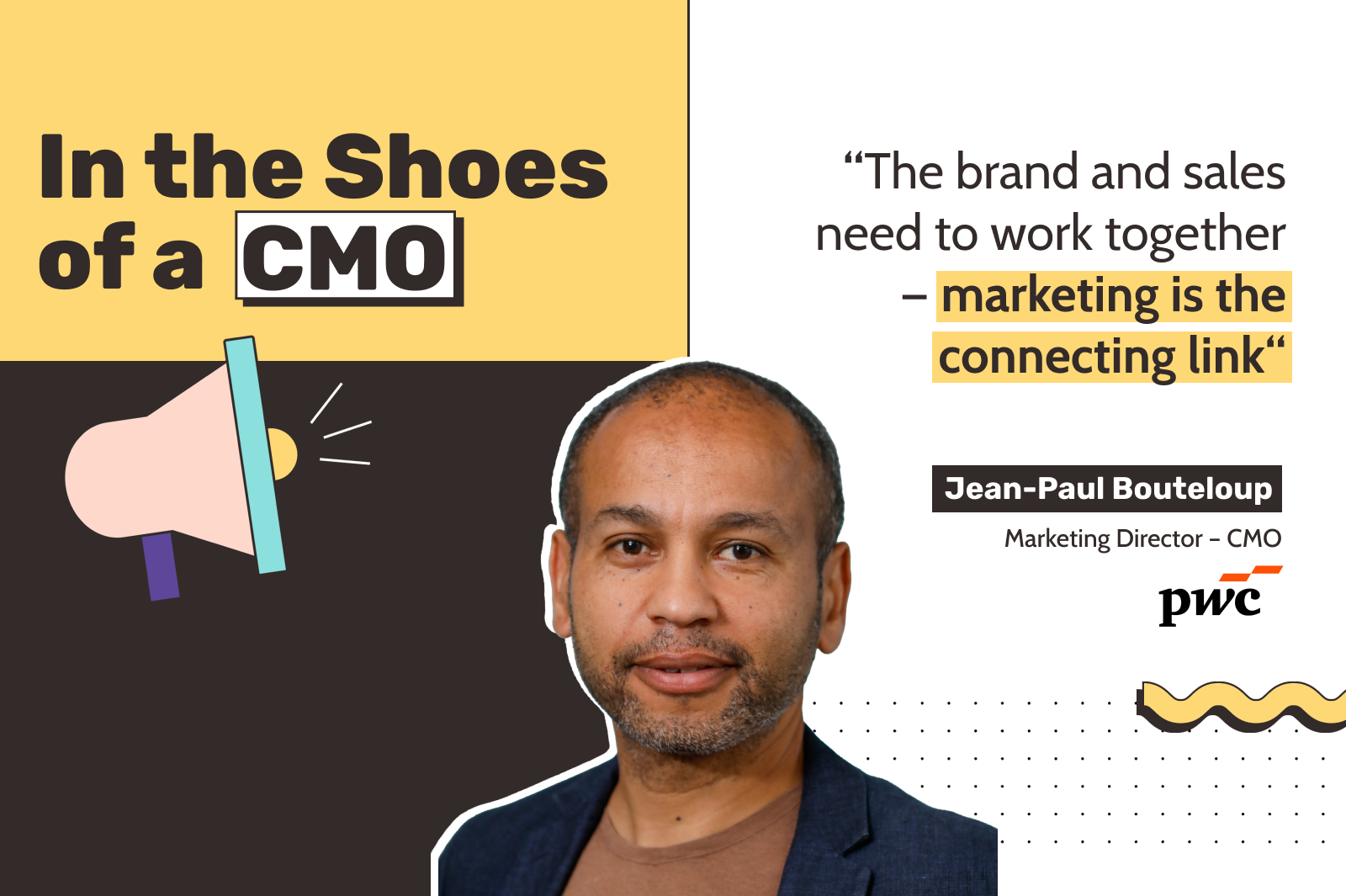
Jean-Paul Bouteloup (PwC France & Maghreb): “Brand and sales need to work together; marketing is the transmission belt between them.”
Marketing Director at PwC France & Maghreb for nearly eight years, Jean-Paul Bouteloup oversees a scope that reflects the scale of the firm: audit, consulting, transactions, legal and tax. Before joining PwC, he spent several years at Adecco, where he led the digital transformation of the group’s customer relationships and marketing processes. This experience of B2B at scale continues to shape the way he sees marketing: as the engine that builds brand positioning and accelerates commercial momentum.
Jean-Paul Bouteloup: The question of where marketing sits within the organisational hierarchy is often presented as a structural one. I actually think it is fairly secondary. What matters is that marketing has enough influence over both dimensions: the brand and the business. Brand and sales need to work together; marketing is the transmission belt between them. When marketing becomes too focused on one side, it comes at the expense of the other.
At PwC, we operate across multiple business areas, so it is easy to lose sight of brand positioning if we respond only to immediate commercial priorities. Yet trust in a brand is what withstands comparison. It is an asset that we perhaps tended to underestimate when markets were evolving more slowly.
That said, spending time close to sales has its benefits: it helps build a common language and mutual trust. Without that, lead generation does not really work.
J-P.B.: The commercial model of professional services firms has changed significantly. Historically, PwC operated like many players in professional services: networking, relationships and inbound enquiries. Partners were the primary, and often the only, commercial drivers. That model is no longer enough.
I had observed the same transition at Adecco when the sales teams had to transform. The customer relationship is now spread across a multitude of interactions: employees who represent the brand, identify weak signals and feed information into the CRM. Marketing needs to capture all of this, structure it and use it to build a more proactive approach.
In practical terms, we think in terms of buying groups rather than individual functions. Our targets are all C-suite executives at large companies and mid-sized businesses. Gartner points out that B2B buyers spend only 17% of their time meeting with a supplier. So you need to be there at the right time, with the right person. Marketing’s role is to maximise those chances.
J-P.B.: We need to distinguish between two levels. First, when it comes to purchasing professional services, LLMs make it considerably easier to compare providers based on pure expertise. Paradoxically, this increases the importance of less comparable differentiators: trust, relationships and the added value created through commercial interactions. Brand factors are becoming more powerful again, not despite AI, but because of it.
Then there is the impact on our marketing practices. We gained early access to secure environments, which allowed us to educate our teams quickly. One of the first practical use cases was using AI to build and challenge personas and ICPs. Between the initial brief and the delivery of a campaign, it is easy to lose sight of your ideal customer. Regularly challenging that framework at every key stage of the process helps us remain focused on the target.
The second contribution is more structural: AI allows us to do things we simply could not do before. For example, carrying out a complete market review before every campaign, producing an immediate competitive landscape or analysing the quality of addressable data files. These were all things that existed in fragmented form, known by a few people but never truly shared. AI makes it possible to systematise them.
J-P.B.: AI does not solve that problem yet, but I wonder whether it is really still a problem today. A growing share of our audience may never consume a piece of content directly: instead, they will consume an AI-generated digest of it. Technical content, however dense, can be ingested and summarised by an LLM. The challenge is therefore no longer simply to make expert content accessible to humans, but also to ensure that it is well adapted to the systems that will read it. GEO is not an option; it is a reality that our buyers are already experiencing.
J-P.B.: The rule I have set for myself is never to create isolated capabilities internally. Having just one person who masters a specific topic creates a capability at risk and a dead end in terms of career development. Either you can build a genuine team around it, or you outsource it.
In practice, we work with external partners on the technical aspects of marketing automation, on certain campaign tactics and on media buying. The idea is to move quickly and execute well on topics we do not fully master or are approaching for the first time, by relying on people who work on them continuously.
J-P.B.: Curiosity, above all. Not declared curiosity, but curiosity that translates into behaviour. What I am looking for is someone who asks themselves how things could be done better or differently, and above all, to what end. Not “I automate” as an automatic reflex, but “I automate to free up time so that I can connect signals I was not able to see before.”
In addition, in our industry, technology, regulation and transactions are topics that constantly influence one another. A marketing leader who remained confined to their own area would miss what really matters.
J-P.B.: Every profession evolves. Each year, I conduct a study among CEOs in France, and their role is also evolving very quickly. This is not unique to the CMO.
What characterises this moment is the speed at which major trends are colliding with one another. Geopolitics, demographics, technology and sustainability: these issues are accelerating and becoming increasingly intertwined, and the CMO needs to build organisations capable of keeping pace.
One thing is certain: today’s CMO cannot consider themselves exempt from understanding technology simply by delegating it to their teams. It is by embracing it themselves that they can truly stay ahead of the curve.
L’équipe Spaag.
Spaag is a consulting firm specialising in growth marketing, digital marketing, data, and AI. Our mission is to support our B2B and B2C clients in achieving their business objectives, both in France and internationally.




.png)