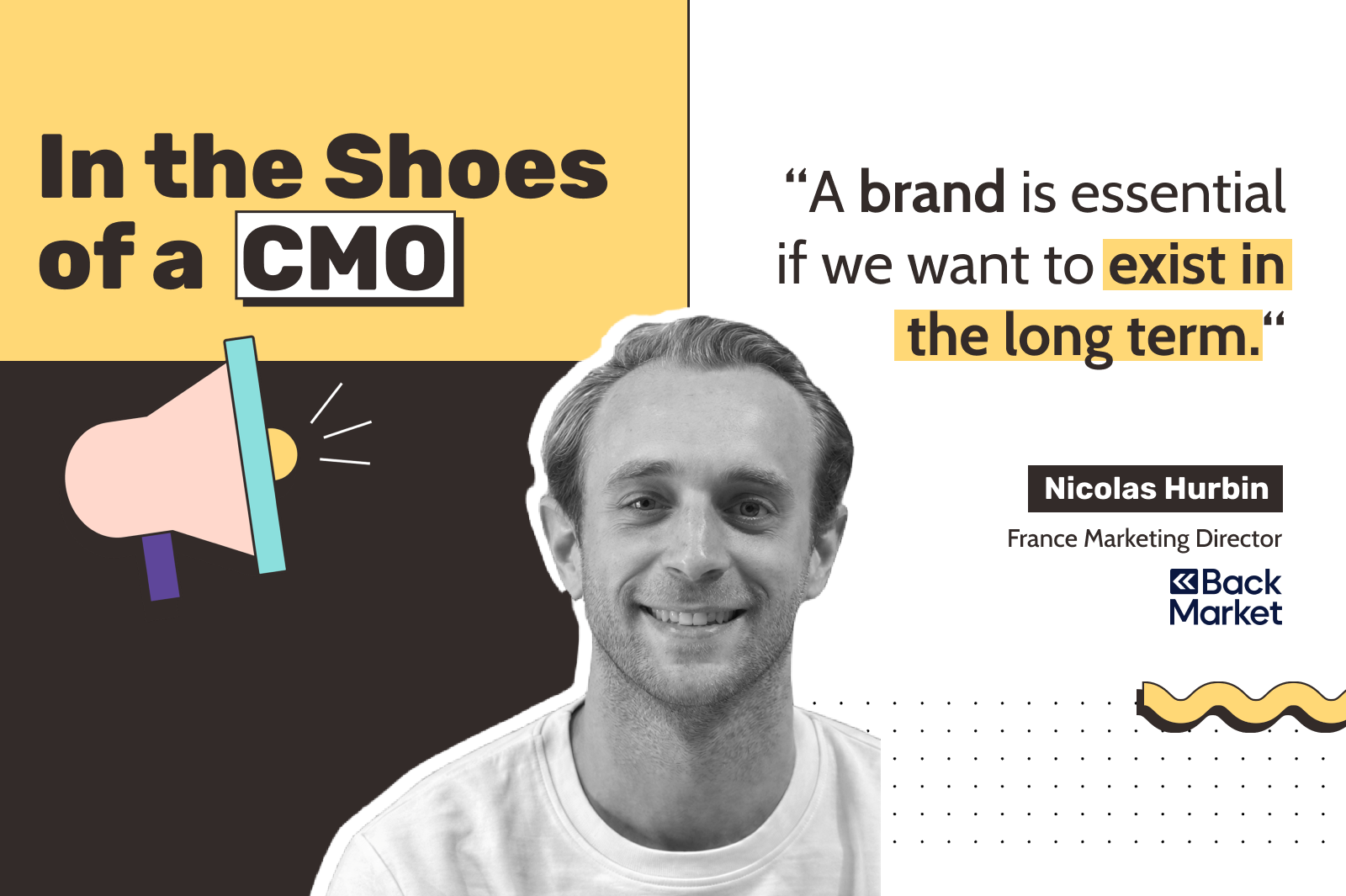
In the Shoes of a CMO: Nicolas Hurbin (Back Market) on Brand Building, GEO and Local Marketing Challenges
Growth Marketing
BtoC
Marketing
Marketing Director France at Back Market since September 2025, Nicolas Hurbin oversees all marketing for the country, with a focus on brand. Back Market's organisation is unusual: its marketing specialists work across multiple countries, and Nicolas Hurbin has an extremely small team. To move his projects forward, he has to convince rather than decide. Before Back Market, Nicolas spent eleven years at Red Bull, then led marketing at two startups, iziwork and La Tournée.
In 2025, Back Market reached profitability at group level for the first time: €3 billion in sales on the platform, 700 employees across 17 markets. France remains its main growth engine.
Nicolas Hurbin: The first is business impact. France is our most mature market: one in two French people knows Back Market. We have moved well beyond the circle of early adopters, and the challenge now is to reach a broader audience, across a wider range of products. We are currently the leading phone reseller in France, but refurbished also covers other products such as kitchen equipment, home care and video games. These categories help us recruit new audiences who often go on to switch to buying their phone with us. Expanding the catalogue and winning new customers reinforce each other.
The second challenge is more fundamental: trust. Refurbished still suffers from being confused with peer-to-peer second-hand, even though buying on Back Market has nothing in common with Vinted or Le Bon Coin. Our sellers are professionals who refurbish the products themselves. Yet many people considering making the switch still need reassurance about warranties, battery condition, and what happens if something goes wrong. That is where we are focusing a lot of energy today.
N.H.: When I arrived, one of my priorities was to properly segment our core targets. Historically we worked with fairly broad personas, which made decisions difficult, particularly for media buying. So we redefined our audiences around one main axis: appetite for refurbished. Is the person already in the category, on the threshold, or rather rejecting it?
Within each of these groups, we built two or three concrete personas, first for France, then rolled them out to the other markets. I use them mainly as an internal teaching tool. Not as an absolute truth, but to help us make better collective decisions.
N.H.: In France, only three of us work exclusively on local market issues. The rest of the marketing team is organised by specialist function and serves all countries. These teams operate as a shared pool of experts for every market: they hold the functional expertise, and my role is to give them momentum and make sure their work serves the right priorities for France. With no reporting line to them, the relationship relies entirely on explaining and convincing.
N.H.: Sometimes, yes. Global naturally favours initiatives with a better ROI that can impact as many markets as possible at once, which makes country-specific topics structurally less of a priority. But France is at a level of maturity the other markets have not yet reached. What works here does not necessarily work elsewhere, and vice versa. Athlete sponsorship, for example, was not on the radar at first. I had to convince leadership that it was a relevant lever for our market. That is also the role of a country marketing director in this structure: feeding global thinking from the local level, not just executing downwards.
N.H.: First, the long term. With a partner over time, you build stories, you get regular visibility points and real integration into their daily life. A one-off creator might work with a competitor the following month. There is also earned media: a high-performing athlete generates media attention through their results, beyond what we have directly paid for. And there is a product proof element that I find particularly powerful: if a top-level athlete uses a refurbished watch in training, it says something no reassurance campaign could say as well.
We started with Baptiste Chassagne, a committed ultra-trail runner, because we saw a natural bridge between an outdoor sport and Back Market's identity. This year we added surfer Marco Mignot, skateboarder Joseph Garbaccio and triathlete Sandra Huon. Niche sports, deliberately, to speak to highly engaged communities.
N.H.: We have an in-house studio with a lot of people, so our production capacity is already strong without relying on generative tools. We mainly use AI to adapt ad formats, repetitive tasks with low creative value. We don't create brand visuals with generative AI.
On the other hand, we have made clear choices on GEO. We closed our local Instagram accounts to redirect to the global accounts, and we are reinvesting in YouTube and Reddit, conversational platforms that heavily feed LLMs. A customer comment on Reddit isn't branded, so models perceive it as more credible. It's a way to exist in AI search answers without producing classic brand content.
N.H.: Above all, I look for generalist profiles, able to understand performance, media buying and influence, while having real expertise of the market: its competitors, its trends, its specificities. Large organisations produce highly specialised experts, but often lose the profiles capable of connecting all these disciplines. At Red Bull, I was a generalist by definition and my speciality was my territory. That is exactly the mindset I am trying to reproduce here.
N.H.: It depends on the company and the context. In difficult economic situations, marketing is often reduced to the short term and pure sales. I understand those constraints, even though we know brand is essential to last over time. The two approaches aren't incompatible, they simply need to be balanced intelligently. At Back Market, the question arises less. Brand has been in the company's DNA from the start, and the fact that performance is well under control allows us to invest in brand without it being seen as secondary. In my view, the topic probably makes more noise than it reflects the reality on the ground.
L’équipe Spaag.
Spaag is a consulting firm specialising in growth marketing, digital marketing, data, and AI. Our mission is to support our B2B and B2C clients in achieving their business objectives, both in France and internationally.




.avif)