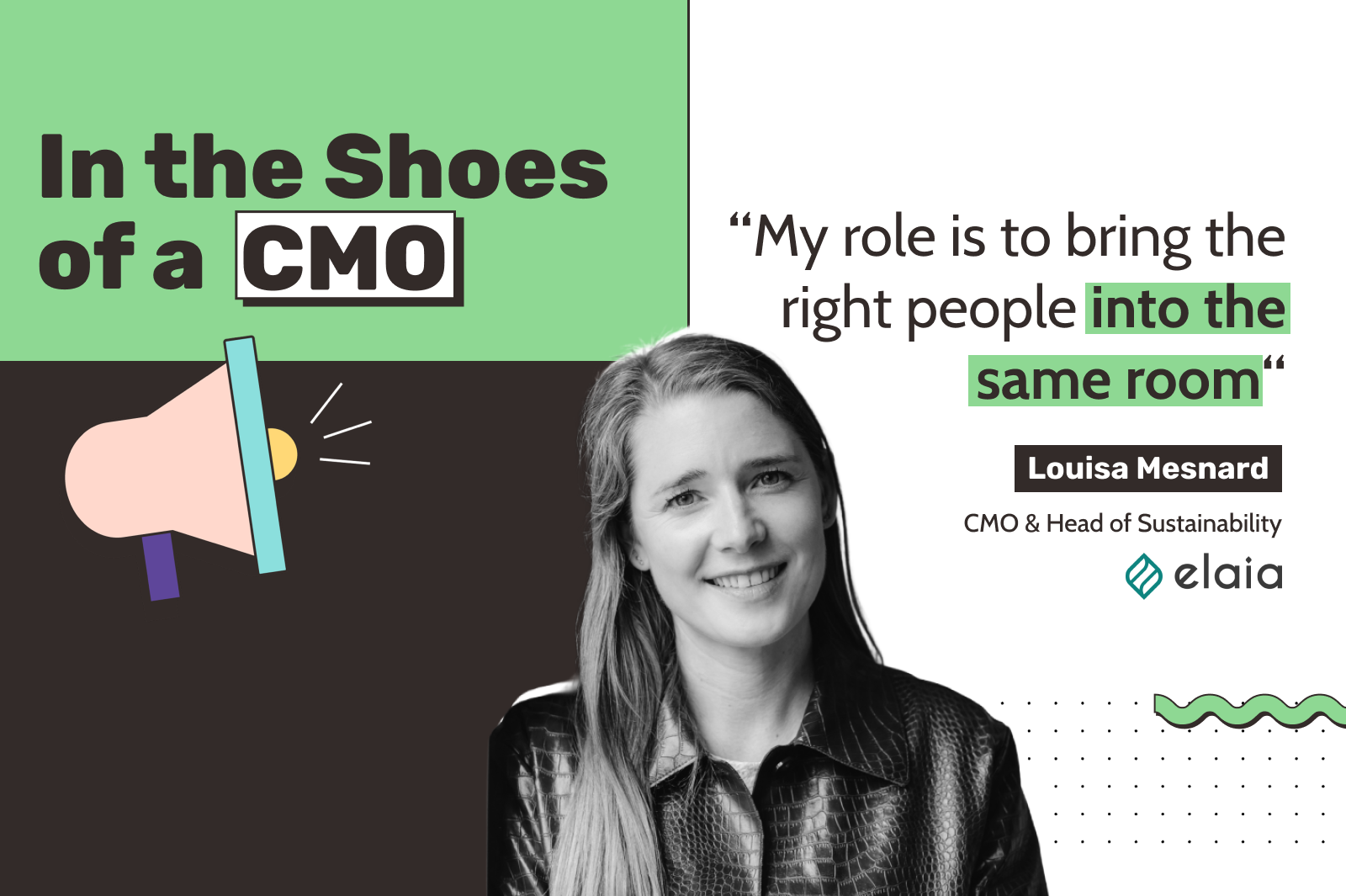
In the shoes of a CMO: Louisa Mesnard (Elaia) on the power of network, brand, and AI in venture capital
Marketing
Key Takeaways
At Elaia, Louisa Mesnard wears two hats. As the fund’s CMO for the past eight years, she is also head of ESG and works for both Elaia—a venture capital investor in tech and deeptech with investment tickets ranging from €500,000 to €15 million—and for Lazard Elaia Capital (LEC), the joint venture between Lazard and Elaia dedicated to growth equity with ticket sizes of €20 to €60 million.
This positioning requires speaking two very different languages: on the one hand, with the investors who entrust them with their money, also known as LPs (Limited Partners), and on the other hand, with the 110 start-ups in the portfolio and the entire ecosystem.
Marketing here is far from the classic B2B or B2C codes, within a function that is still young. When Louisa Mesnard took on her role, there were only two or three CMOs across all funds. Today, there are an estimated fifty or so, including around thirty in venture capital alone.
Louisa Mesnard: The integration of artificial intelligence is an obvious priority, both in our processes and in the tools we are testing. The realm of possibilities opening up is fascinating.
The other challenge concerns the development of strategic partnerships with players like Anthropic or Nvidia to support our portfolio companies.
L. M.: Marketing for a fund like Elaia addresses two audiences with very different mindsets—LPs and start-ups—but it actually answers a single underlying challenge: building a brand strong and differentiated enough to provide access to the best tech investment opportunities. In a market where quality deal flow depends on financial track records but also on reputation, the brand is a true strategic asset.
Our added value lies in our ability to create the right connections at the right time. We don't claim to have all the answers, but we know how to identify people in our network who have the relevant experience or expertise, and bring them around the same table to foster concrete and useful discussions.
This logic also applies to external partners. We only recommend someone if they have already been recommended by at least two of our portfolio companies, to avoid bias and build a sort of community. Most often, this is an individual rather than an agency.
L. M.: Communication directed at LPs is almost never public; it's a bit like the secret sauce of every fund. Beyond financial and regulatory reporting, the challenge is to tell the story of what is happening in our portfolio.
Why we believed in a team at the time of investment, or what made an exit possible. For example, we gave our investors a detailed account of the highly successful sale of Vibe to Walmart, announced at the end of June 2026. This operation, which marks the successful exit of a French start-up in which Elaia was an early investor, illustrates our ability to identify high-potential companies very early on and support them through to major liquidity events.
Our positioning in the market is unique. The fund was co-founded by a mathematics researcher, and our team includes several PhDs. This deeptech foundation sets us apart, and we lean on it. There is also an entire engagement strategy dedicated to LPs, through events that strengthen the relationship, tangibly illustrate the value of our ecosystem, and help encourage those who haven't yet taken the plunge to join our investor base.
L. M.: This is a classic topic in our line of work—return on investment. After every dinner we host in our offices, something almost always happens, such as a recruitment or a new business connection. But these results tend to materialize over the long term, rarely immediately, which makes tracking difficult. We systematically send out anonymous feedback forms, which allows us to know our average rating, and whenever an event deviates from it positively or negatively we dig deeper to understand why. The bulk of our tracking focuses on how these meetings informally serve the business, rather than on traditional lead generation metrics.
Sourcing follows the same logic. We receive about 5,000 applications a year for around ten investments, and at such a volume, the quantity of applications matters less than their quality. In fact, we have never invested in a company that only contacted us via our website. There are other, more personal ways to get in touch with us—by email, via LinkedIn, or at the numerous events we organize. GEO (Generative Engine Optimization) is also a channel that has recently gained importance.
Start-ups are now asking tools like ChatGPT or Claude which funds to target based on their thesis, a topic we are actively working on.
L. M.: It's everywhere. My meetings are systematically recorded, which allows me to stay focused on the conversation rather than on taking notes. We have also created several agents for specific uses related to our business, as well as for efficiency. Day Prep, for example, prepares our day every morning at 7 a.m. It cross-references our emails, past meetings, and data from Affinity, our CRM, to tell us who we are meeting and to identify urgent emails, for which it prepares draft responses.
L. M.: We opted for a hybrid model, which allows us to keep the most strategic functions in-house while flexibly mobilizing external expertise. We look outside for what we don't have internally, as well as for a bit of extra bandwidth during the busiest times of the year, like the month preceding our Founder Summit.
We rely on a network of about ten freelancers, each specializing in a specific field, such as video, photography, or design. We also worked with an agency for our current rebranding.
Events management, on the other hand, remains entirely in-house. Between the three of us, we coordinate the content, branding, and logistics. This complementarity allows us to maintain control over our events and turn them into a real lever for influence and relationship-building with our ecosystem. In some years, we have organized up to fifty events.
When recruiting, I look above all for open-mindedness, an ability to learn, and adaptability. We don't necessarily look for profiles from the venture capital world. My latest recruit came from the art world in New York, with no prior experience in venture capital or the French tech scene, but with a solid background in marketing, communication, and event organization. She was quickly able to understand our environment and discover venture capital. What matters is bringing a fresh perspective and being able to quickly develop one's expertise.
L. M.: Knowing how to adapt, depending on the stage of development of each company and each request. This first implies building internal buy-in. Since communication is not the core profession of most of our contacts, we have to convince teams to dedicate time and make marketing a collective effort. Externally, this relies on building long-term relationships with key stakeholders, notably journalists and players in our ecosystem.
This profession remains above all a human endeavor, which is what still fascinates me after eight years.
L’équipe Spaag.
Spaag is a consulting firm specialising in growth marketing, digital marketing, data, and AI. Our mission is to support our B2B and B2C clients in achieving their business objectives, both in France and internationally.