.png)
In the Shoes of a CMO: Naëlle Hadji-Bormann (Day One) on AI, Growth Marketing and the Evolving Role of the CMO
Growth Marketing
28/9/26
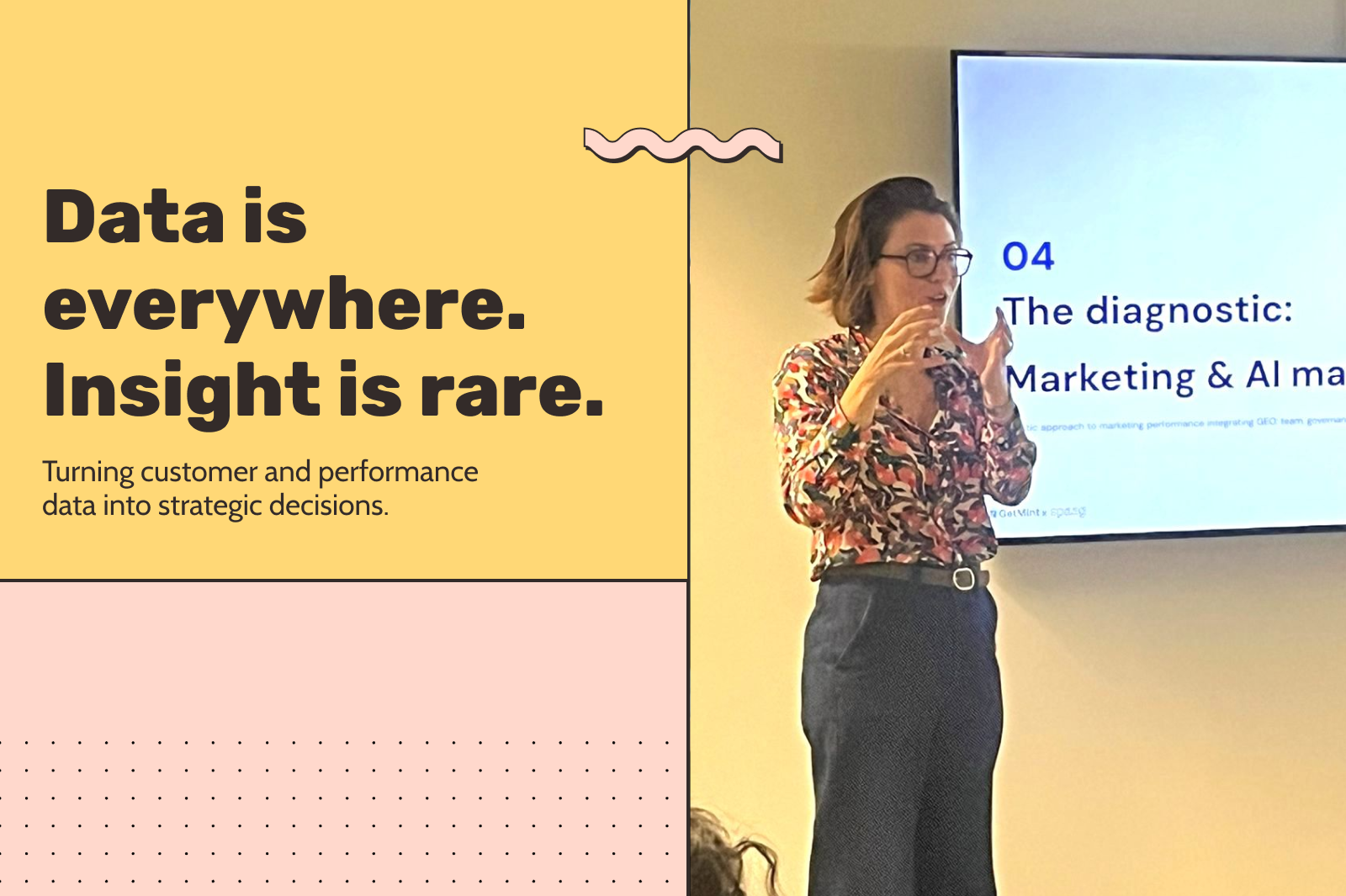
Naëlle Hadji-Bormann has built her career across major corporations and startups, from BNP Paribas and RATP Dev to FollowAnalytics, October and Modjo. She is now CMO and Partner at Day One, a platform that connects companies and nonprofits through skills-based volunteering. There, she leads a marketing team made up entirely of freelancers. In this interview, she discusses how her profession is evolving, the role of artificial intelligence and the decisions reshaping the CMO's responsibilities.
Naëlle Hadji-Bormann: I see three main challenges. The first concerns the structure of the marketing team. Twelve years ago, I recruited internally, and flexibility essentially meant choosing between permanent and fixed-term contracts. Today, freelancing is booming. Marketing budgets are under so much pressure that hiring freelancers is often the first option considered, even before thinking about recruiting in-house. This changes management dynamics and how resources are deployed.
The second challenge is the evolving definition of marketing. In the past, functions were clearly separated: market research, digital marketing, operational marketing and so on. At least, that was my experience in large corporations. Today, marketing has become all-encompassing, and team members are expected to have cross-functional skills spanning acquisition, branding, public relations, data and growth marketing campaign optimization. The third challenge is the emergence of artificial intelligence over the past five years.
N.H-B.: Internally, AI has been widely adopted. It has become a shared objective across all departments. During our cross-functional meetings, each team shares its use cases.
The impact on content production is tangible. For example, we now take three times less time to produce a white paper.
We're also reviewing around fifteen AI agents offered by our CRM platform, HubSpot, to identify which ones are relevant to our needs. One ongoing project involves an AI agent that could support us in responding to requests for proposals (RFPs). This would have a direct impact on our ability to respond to larger opportunities.
N.H-B.: No, and it's a delicate balancing act. Our paying clients are companies, but our nonprofit partners are just as important to our ecosystem. When we first discussed artificial intelligence with nonprofits, the response was more cautious. These are organizations driven by strong human values, working on issues such as illness and social reintegration.
Introducing the idea of integrating AI into our solution therefore required a reassuring approach. We needed to develop messaging that would preserve this essential relationship while clearly demonstrating the benefits of using AI, such as helping nonprofits write volunteer recruitment announcements.
N.H-B.: I deliberately refer to prospects rather than clients. My role is to strengthen inbound acquisition and ensure that leads are properly qualified before they become potential business opportunities and, eventually, paying customers. We work upstream to qualify prospects as thoroughly as possible and understand their level of maturity when it comes to employee engagement. For example, we've completely redesigned our contact forms to collect more relevant data.
This qualification process continues on the sales side. We've implemented a lead scoring system. Whenever a new lead comes in, both marketing and sales receive a shared notification indicating how closely that lead matches our target profile.
Today, more than 65% of our sales opportunities are generated by marketing. This makes collaboration between sales and marketing even more important. At Day One, we actually consider ourselves a single team: the Revenue Team.
N.H-B.: Overall, there's very little friction. The only area where I've had to spend time educating certain members of the leadership team is employee advocacy. However, demonstrating how employee advocacy could increase Day One's visibility at zero cost quickly encouraged adoption. In fact, the number of communications shared or published by our employees is continuously increasing.
I'm also working on introducing a new brand awareness component into our quarterly investor reports, alongside our business performance indicators. The idea is to demonstrate that investors aren't just investing in a solution, but also in a brand that generates conversations and attracts attention externally, while internally motivating employees to stay.
This reflects a broader challenge. Marketing budgets are tightening everywhere, and we now have to demonstrate the return on investment of every euro spent. We continue to invest in brand awareness, even though it comes at a cost, through partnerships with organizations such as France Digitale, the Positive Company label and Carenews, a media outlet specializing in corporate social responsibility (CSR).
N.H-B.: We recently had this discussion about Generative Engine Optimization (GEO).
Our CEO was very enthusiastic about investing in GEO, driven by everything she'd heard and read about it.
Together with the freelancer who supports me on these topics, we decided to take an analytical, evidence-based approach. We reached out to a community of marketing professionals to gather feedback before making a decision. Ultimately, we decided to keep GEO on our radar without making it a priority, allocating virtually no budget to it for now.
I'd rather strengthen our existing paid search (SEA) strategy, which indirectly supports GEO and has been delivering results for the past four years, than launch an entirely new initiative requiring time, training and initial experimentation that won't necessarily produce immediate results, given its long-term nature.
N.H-B.: I no longer work with agencies, not as a matter of principle, but for pragmatic reasons. I've known my current freelancers for a very long time. We've worked together in previous roles, which saves us valuable time on projects where we need to deliver results quickly.
Recruitment follows a different logic depending on the size of the company. In large corporations, I looked for highly specialized expertise because organizational structures tend to be siloed. In startups, it's the opposite: I look for versatile, multidisciplinary profiles.
For example, my designer handles our content design, makes updates to our website and schedules our social media posts. Without this versatility, we'd stretch ourselves too thin.
L’équipe Spaag.
Spaag is a consulting firm specialising in growth marketing, digital marketing, data, and AI. Our mission is to support our B2B and B2C clients in achieving their business objectives, both in France and internationally.