January 14, 2026
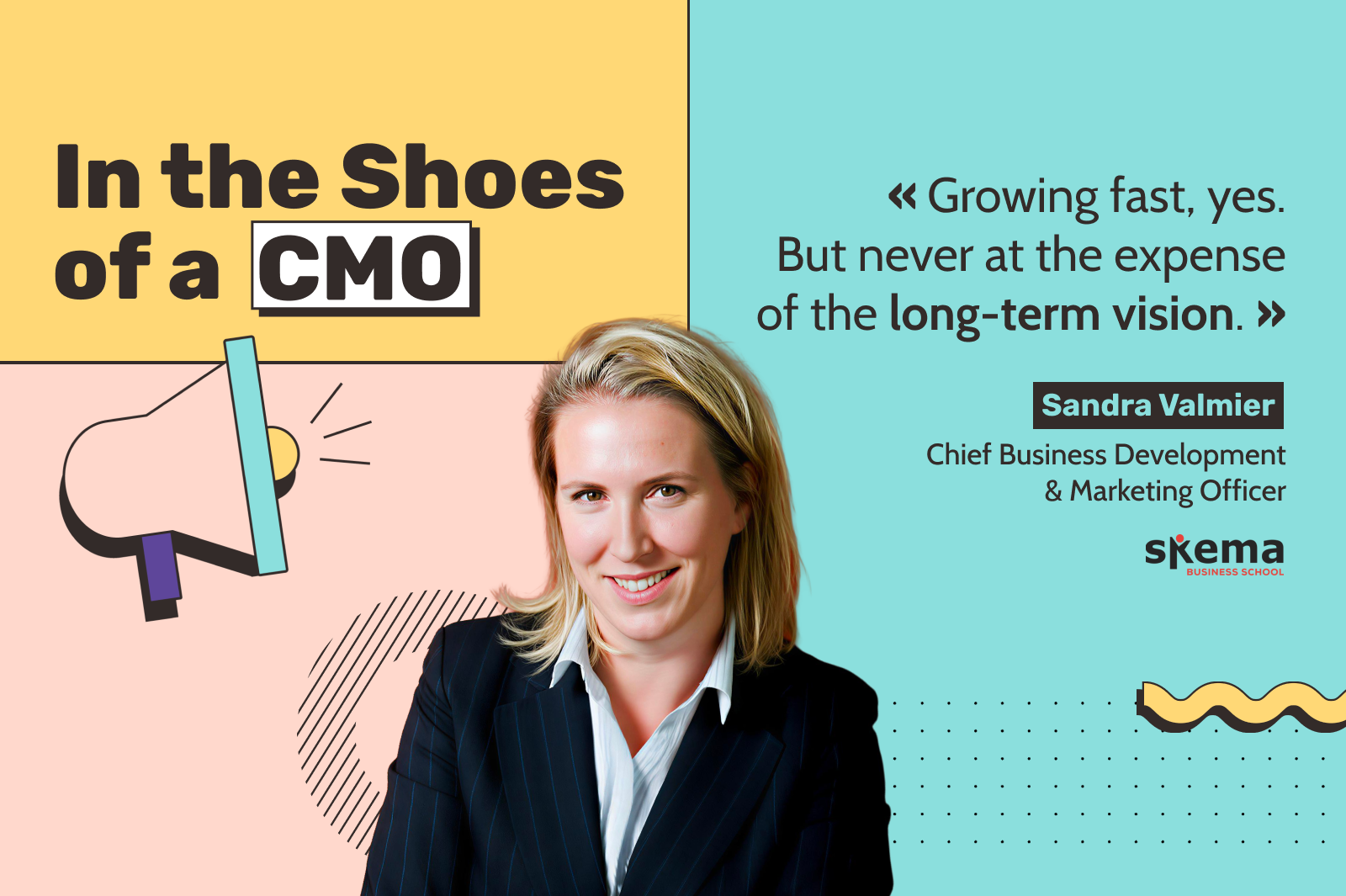
In the shoes of a CMO: Sandra Valmier, CMO at SKEMA Business School
Growth Marketing
Hyper-croissance
hypergrowth
Marketing
January 14, 2026
14/1/26
In the shoes of a CMO
Sandra Valmier (SKEMA Business School): “Growing fast? surely, but never at the expense of long-term vision.”
Having joined SKEMA two years ago, Sandra Valmier leads a critical scope: marketing, development, and admissions for a school present across nine campuses worldwide, with 50% international students. After fifteen years in consulting and in the world of business law firms, she moved into a global education model where brand, data, technology, and international reach must advance in sync. In a sector undergoing profound change (global competition, evolving student expectations, pressure on standards), she champions a marketing approach deeply embedded in the value chain—one that stays ahead without compromising academic excellence.
Sandra Valmier: The number one challenge is people. Marketing skills are evolving very quickly: data, digital, AI, growth mindset… Even sales teams need to develop strong marketing culture. Marketing and admissions are now inseparable. That means being able to capture field signals, understand usage patterns, and work in true cross-functional collaboration.
The second challenge is technological transformation. To build the ideal student journey, you must be willing to reinvent processes—even when everything seems to be working. It’s counter-intuitive, but essential. SKEMA is on a growth trajectory in both size and rankings. To maintain that momentum, you sometimes need to “break what’s working” before it becomes obsolete. Finally, digital: the school was already active digitally, but we needed to move beyond the traditional codes of the education sector. We sought inspiration elsewhere, notably through our collaboration with Spaag.
S.V.: They are changing very fast—and very differently depending on the country. That’s why we launched Youstalk, the largest global survey of young people aged 16 to 25. The first insight is clear: there isn’t one single “youth,” but multiple youths. Chinese youth do not expect the same things as French youth. Some international students live in politically unstable regions and do not all have access to Western standards of comfort. More broadly, responses can be difficult to reconcile: while students associate success with money, their real priorities are peace and health.
For us, this means two things. First, integrating social responsibility into all our programs. Second, preparing students to evolve in an uncertain world. The skills expected reflect this reality: a foundation in law and geopolitics, design to think through customer experience, hybrid skill sets, and AI embedded across all programs (“AI for business”). The education model has changed—we no longer train only managers, but profiles capable of understanding the world in all its dimensions.
S.V.: The education market has become global and hyper-competitive. A top student compares SKEMA programs not only with HEC, but also with institutions in the United States or Asia. The decision is a moment of truth for both students and parents: it is a major investment and a life choice. Our model remains disruptive and uncompromising on quality. All our programs are degree-granting, accredited, and aligned with the highest standards. That is SKEMA’s strength: growing fast without compromising quality. Our strategic plan, UNVEIL, aims to help everyone reveal their potential. This requires innovation, the right partnerships, and support for more flexible and personalized pathways.
S.V.: The brand sets the direction, but data drives day-to-day operations. The acquisition cycle is complex: sourcing students worldwide, entrance exams, academic selection, sometimes visa approval, and final enrollment. Every step is carefully monitored to qualify the funnel.
There is also a sector-specific reality: marketing drives the business logic, while academics drive the selection logic. A program does not recruit “at any cost”—it welcomes students who meet the expected academic level, who will graduate, and who will ultimately carry the SKEMA brand. We therefore constantly arbitrate between volume and standards.
We apply a form of yield management: recruiting enough students, on time, without overcrowding classes or degrading the student experience. This is only possible through very close cooperation between marketing, admissions, and program leadership.
S.V.: For the Grande École program, we needed to clarify our value proposition and move beyond the traditional, highly standardized education messaging. With Spaag, we challenged our angles, prioritized what truly differentiates us, and created a more ambitious campaign with an original creative concept. What I value most is the genuine team approach: transparency, iteration, and the ability to say when something doesn’t work. You can’t internalize every skill—so a strong partner provides the perspective needed to wake up what has become too comfortable and bring in sharp expertise.
S.V.: Never lose sight of the long term. In this sector, the temptation to optimize only for the short term is strong: more leads, faster, broader. But a school is not built like a digital campaign. I would expect the CMO to strengthen the brand, ensure coherence between the Group’s ambitions and the actual student experience, and make SKEMA a truly global education platform, accessible from anywhere in the world. Growing fast, yes—but always staying true to our level of excellence.
L’équipe Spaag.
Spaag is a consulting firm specialising in growth marketing, digital marketing, data, and AI. Our mission is to support our B2B and B2C clients in achieving their business objectives, both in France and internationally.