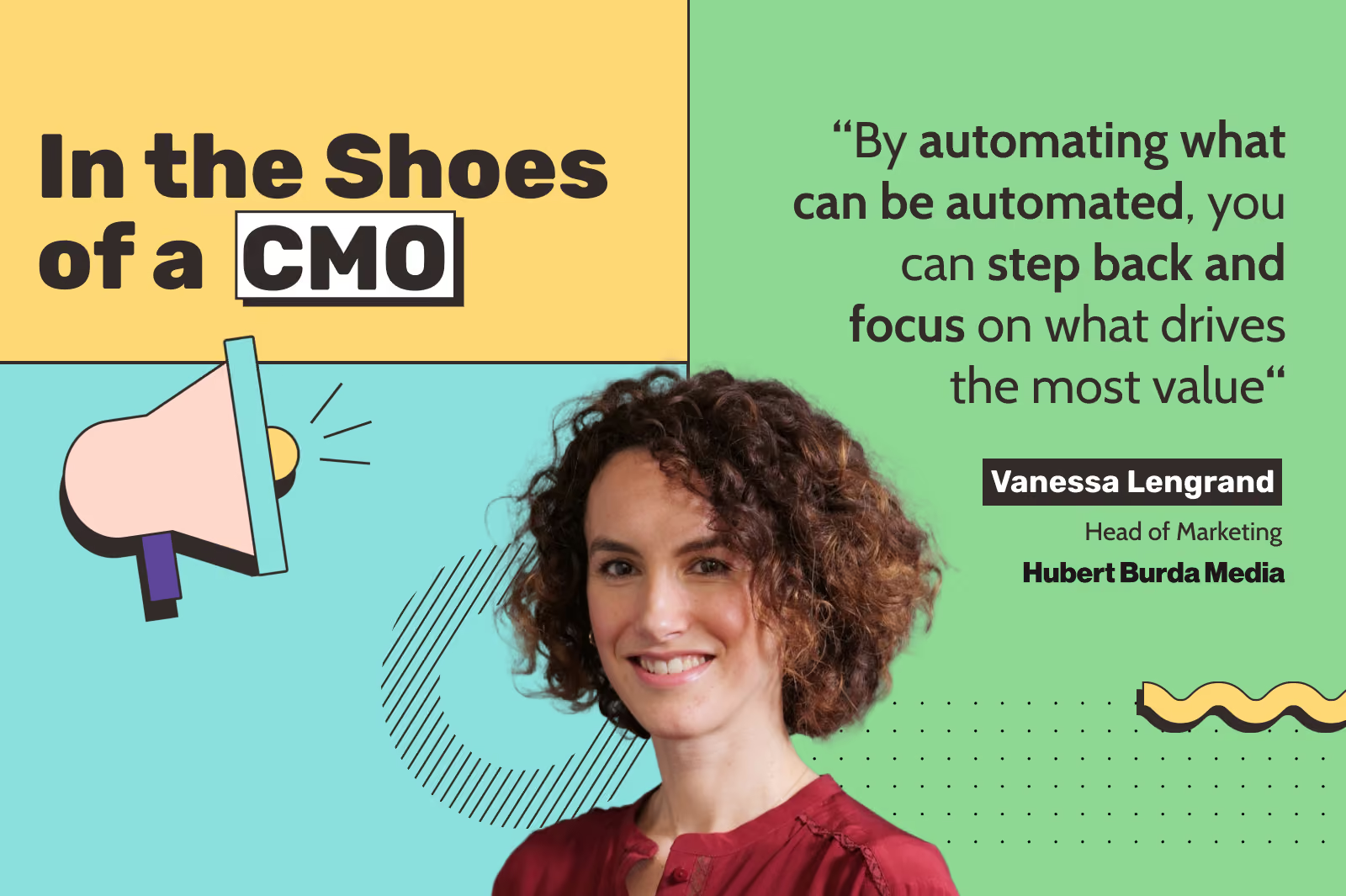
In the Shoes of a CMO: Vanessa Lengrand (Hubert Burda Media) on AI, acquisition and the transformation of media business models
AI
BtoC
Future of marketing
As Head of Marketing and Communications at Burda Bleu, Vanessa Lengrand manages a portfolio of media brands operating in radically different worlds: food with Saveurs, regional heritage with Esprit d’Ici and true crime with Le Nouveau Détective. Burda Bleu is the French subsidiary of Hubert Burda Media, a German family-owned group with more than 500 media products, 9,000 employees across 14 countries and annual revenue of nearly €3 billion.
Her day-to-day challenge is to transform media brands deeply rooted in print into viable digital offerings, without losing audiences that have remained loyal for decades. She discusses the pressures facing media marketing today, from declining print sales and the race to grow digital subscriptions to the impact of AI.
Vanessa Lengrand: Transforming our business models is a major challenge. The magazine industry as a whole is experiencing a structural decline in print sales. We therefore need to adapt by growing digital subscriptions and diversifying our revenue streams, which requires a fundamental shift towards digital behaviours and expectations.
For Le Nouveau Détective, for example, which has existed for almost a century, the question is not how to digitise what already exists, but how to rethink the brand’s territory. Over the past year, we have been developing a video strategy and podcast formats to reach a younger audience that is very different from our print subscriber base.
V.L.: There is almost no overlap between them, which is both a constraint and an opportunity. Developing one does not cannibalise the other, but we need to address very different challenges for each audience. Converting app installations into paid subscriptions requires a completely different approach from increasing print circulation.
We spend a lot of time working on pricing models, trial periods and offers with or without a commitment. With no commitment, the entry price is lower, but the subscriber lifetime is shorter. With a commitment, the opposite is true.
We also need to monitor acquisition costs against customer lifetime value. When we invest heavily in paid media, app installations increase, but conversion does not necessarily grow at the same rate.
V.L.: Yes, and they are very pronounced. Saveurs is highly seasonal, with traffic peaks towards the end of the year. This is when we generate the most traffic, but also when CPCs are at their highest because every brand is competing at the same time. There is a temptation to concentrate investment during these periods, even though this is precisely when acquisition costs soar.
Quieter periods are underused, despite often being much more efficient because both competition and costs are lower. We tend to focus on predictable seasonal moments, when quieter months deserve far more attention than we currently give them.
V.L.: We use it at two levels. Internally, we use AI to simplify content production and its integration across different channels. This allows us to save time on tasks that were previously completed manually.
We have gone further on the customer experience side with the Saveurs app. It contains 12,000 recipes, and we have integrated an AI agent that helps users find recipes based on what they have in their fridge, before personalising them according to their food intolerances. This is a use case that adds tangible value to the digital subscription, rather than simply reproducing the magazine in a digital format.
We are also exploring generative engine optimisation, or GEO. It is still relatively new, but it is gaining momentum, particularly in content-to-commerce. Integrating partner brands into our content can help those brands appear in the answers generated by AI models. For a publisher whose business model partly depends on promoting brands, this is an opportunity worth exploring.
V.L.: We begin by testing them internally, before evaluating them with readers through research, surveys and focus groups. We also speak to non-readers who have an interest in the topics covered by our brands.
For the Le Nouveau Détective app, we had considered integrating games, as many media companies are doing. The focus group showed us that this was not what the brand’s readers expected. Being challenged by users is useful. It prevents us from investing in directions that may appear logical internally but do not align with the brand’s true identity.
Video, on the other hand, worked. Once the concept had been validated, we created a dedicated studio within the editorial team. This is often the role of marketing: to test, identify what works and then transfer the capability to the part of the organisation where it makes the most sense.
V.L.: It is a central relationship. We sell content, so marketing needs to identify which content drives acquisition. We bring a business perspective to editorial teams through data, audience behaviour and conversion rates. In return, they bring the topics, the editorial direction and the news agenda. Both perspectives are essential.
V.L.: Analytical thinking has become essential, even in teams that were not historically data-driven. Reading figures, interpreting them and turning them into concrete recommendations used to be the responsibility of data teams. It is now expected of everyone.
What seems equally important to me, however, is curiosity and the ability to question your own assumptions. The media market moves quickly. What worked last year may no longer be what audiences are looking for.
I also look for people who already use large language models in their daily work, so that they can free up time spent on low-value tasks and focus on the work that requires judgement.
V.L.: I would say that the role is being repositioned rather than disappearing. At the moment, the function is often caught in a cycle of short-term performance demands and constant reactions to new technologies. CMOs can find themselves permanently trying to catch up, which is not the right position to be in.
What technology cannot do is build a desirable brand, anticipate changes in the market rather than simply react to them, or orchestrate the relationship between technology and creativity.
That is where the CMO needs to reposition the role: automating what can be automated in order to regain perspective on what really matters.
L’équipe Spaag.
Spaag is a consulting firm specialising in growth marketing, digital marketing, data, and AI. Our mission is to support our B2B and B2C clients in achieving their business objectives, both in France and internationally.